Third Laboratory | Re-evaluating Brand ‘Cultural Engineering’ and Autonomy in Physical Expression
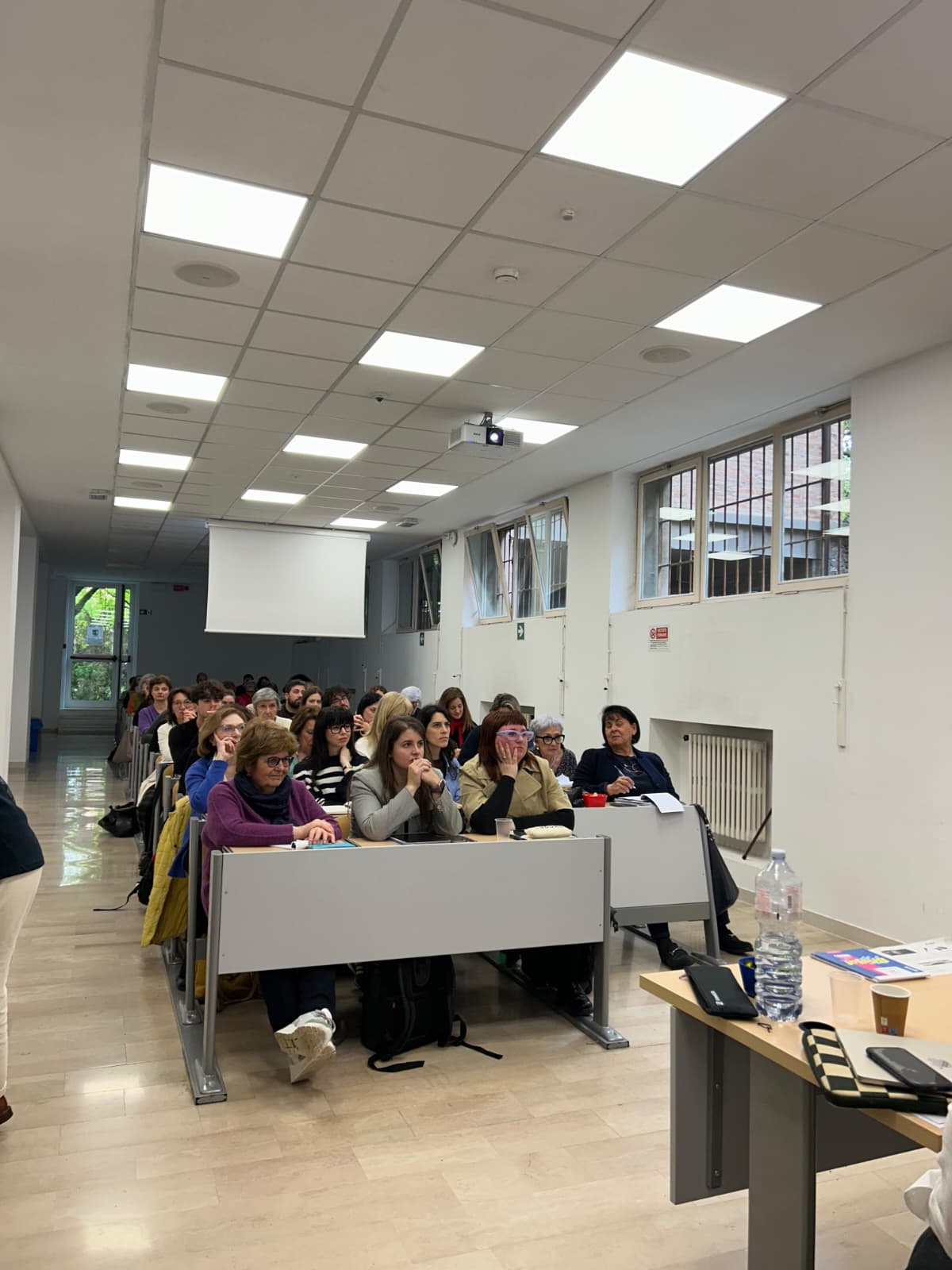
The third session of the We-Frame laboratory series took place on 15 April 2026 at the University of Ferrara. In the ‘Equality and the Body’ workshop, participants discussed the statistical realities and identity challenges of an era dominated by media standards and brand-driven cultural engineering.
The programme of workshops was organised as part of the WE Frame project by the partners CDS, the Department of Law at the University of Ferrara, Traces&Dreams and Officine Europa.
About the project, Monica Cesari from CDS said: ‘The main theme of this project is equality, specifically gender equality. We address concepts of equality and inequality within the CERV project framework, where the funding aims to protect and strengthen European Union rights. We work to preserve the memory of acquired rights and promote them within the EU.’
Data shows a half-century deadlock
The third session began with the presentation of European survey statistics revealing that, at the current rate of progress, it will take Europe at least another 50 years to achieve full gender equality. Monica Cesari, representing the Centro Ricerche Documentazione Studi (CDS), presented detailed statistical analyses from the We-Frame project. Despite slight progress in some areas, she said that overall equality indicators across the EU remain stalled between 63% and 68%. These figures were extracted from responses provided by 723 key stakeholders from various European countries.
The data indicates a significant discrepancy between theoretical knowledge and citizens’ lived experiences:
• Awareness vs. Belief: While more than 89% of participants can correctly define the concept of ‘bodily autonomy’, only 23% believe in the effectiveness of EU macro-policies in combating discrimination.
• Media Impact on Mental Health: Over 71% of respondents believe that media stereotypes directly affect their well-being and self-image.
• Discrimination Among Youth: More than 64% of young people aged 18 to 29 have experienced unfair judgement based on their clothing, lifestyle, or body shape.
As Monica Cesari mentioned, in today’s social context, the body has shifted from a private domain to a battlefield for power and surveillance. These statistics suggest a serious communication breakdown between governing institutions and the public.
The Dominance of Brands and the Body
In the second part of the session, Luca Marchetti, a semiotician and lecturer at Sorbonne Nouvelle University in Paris, examined the powerful social role of brands. Marchetti, who jokingly introduced himself as a man working for the ‘devil’ (the world of brands), explained that his academic work involves rigorously analysing this power and its ethical challenges.
Drawing on the concept of ‘cultural engineering’, Marchetti discussed how brands project shifting values onto products and images. These values are deeply dependent on social, cultural, and anthropological contexts and directly influence how society perceives the body. He said that brands use metaphors and symbolic tools to provide ‘prescriptive’ images that dictate specific ways of being rather than simply offering a simple product.
One key part of Marchetti’s speech was the distinction between ‘representation’ and ‘equality’. He said that brands excel at representing differences and showcasing diverse bodies in advertising catalogues, granting these bodies ‘visual legitimacy’. However, this does not necessarily mean equality. Neoliberal capitalism is adept at absorbing differences and turning them into ‘commercial trends’. In representation, we only see the difference, but true equality occurs when these bodies enjoy identical rights and opportunities in reality outside the image frame. He believes that brand awareness regarding social responsibility and sustainability is often a ‘strategic calculation’ for market survival and image management rather than a deep ethical commitment.
Camilla Caselli, a researcher in law and art, also highlighted the difficulty of building foundations for equality today, raising two essential challenges:
1. Market Access and Identity: Caselli asked how real equality can be created in a space where identity is constantly defined through external elements and clothing. She noted that in a neoliberal environment, we have lost the traditions of making our own clothes and the complex narratives of colour and comfort.
2. Self-Determination vs. Trends: She questioned how much space exists for building an independent identity when the system constantly pushes individuals toward specific ‘trends’ for recognition.
In response, Luca Marchetti stated that the market even anticipates and packages our tools of resistance. He explained that when someone tries to escape a trend through their attire, the market immediately defines and markets that escape as a new style, such as ‘anti-fashion’. Therefore, true self-determination requires constant awareness of the prescriptive nature of brands and the ability to distinguish between genuine choice and cultural engineering.
Afternoon workshop: analysing ‘Equality and the Body’ via group discussions
Following the session, a workshop was held with participants at four different tables, a standard practice for We-Frame events. Monica Cesari said: ‘The areas we focus on in these workshops include the body, intergenerational relationships, intersectionality, and rights. Each working day is dedicated to one of these topics. Today, we worked on “the body”. These activities aim to exchange ideas because this process is built from the bottom up.’
Stakeholders participating in these activities engage in discussion. Although an expert is present in the morning, they enter into a dialogue with participants, ensuring it is not a one-way lecture but a subject discussed collectively. Before this stage, the results of the survey conducted in the first phase of the project were presented.
In the second half of the day, qualitative research is conducted. We follow a path with stakeholders and participants using the World Café methodology and a cognitive map built with the acronym CAMPO. This map includes summary feedback of thoughts raised during the first part of the roundtable discussions. There are four roundtables, and the methodology allows individuals to rotate so that all groups encounter every topic.
At the end of this collaborative work, participants are asked to write notes on Post-its and place them in one of the five sections of the map. The goal is to reach an intellectual synthesis and provide insights useful for scaling the project and disseminating the results.’
Next laboratory: Equality and Vulnerability
The third session of the We-Frame specialised workshop series concluded by establishing a deep link between fundamental concepts of social justice. This path began with a focus on ‘Equality and Differences’ in the first laboratory and continued with the analysis of the relationship between ‘Equality and Power’ in the second workshop. The third workshop sought to understand how the human body has become a battlefield for power and commercial representation. Now, with an increased awareness of brand cultural engineering and social judgements, the series moves toward a more sensitive stage. The next workshop, scheduled for 27 April, will address ‘Equality and Vulnerability’ to explore the hidden layers of human dignity and equal rights in the face of individual and social fragility.