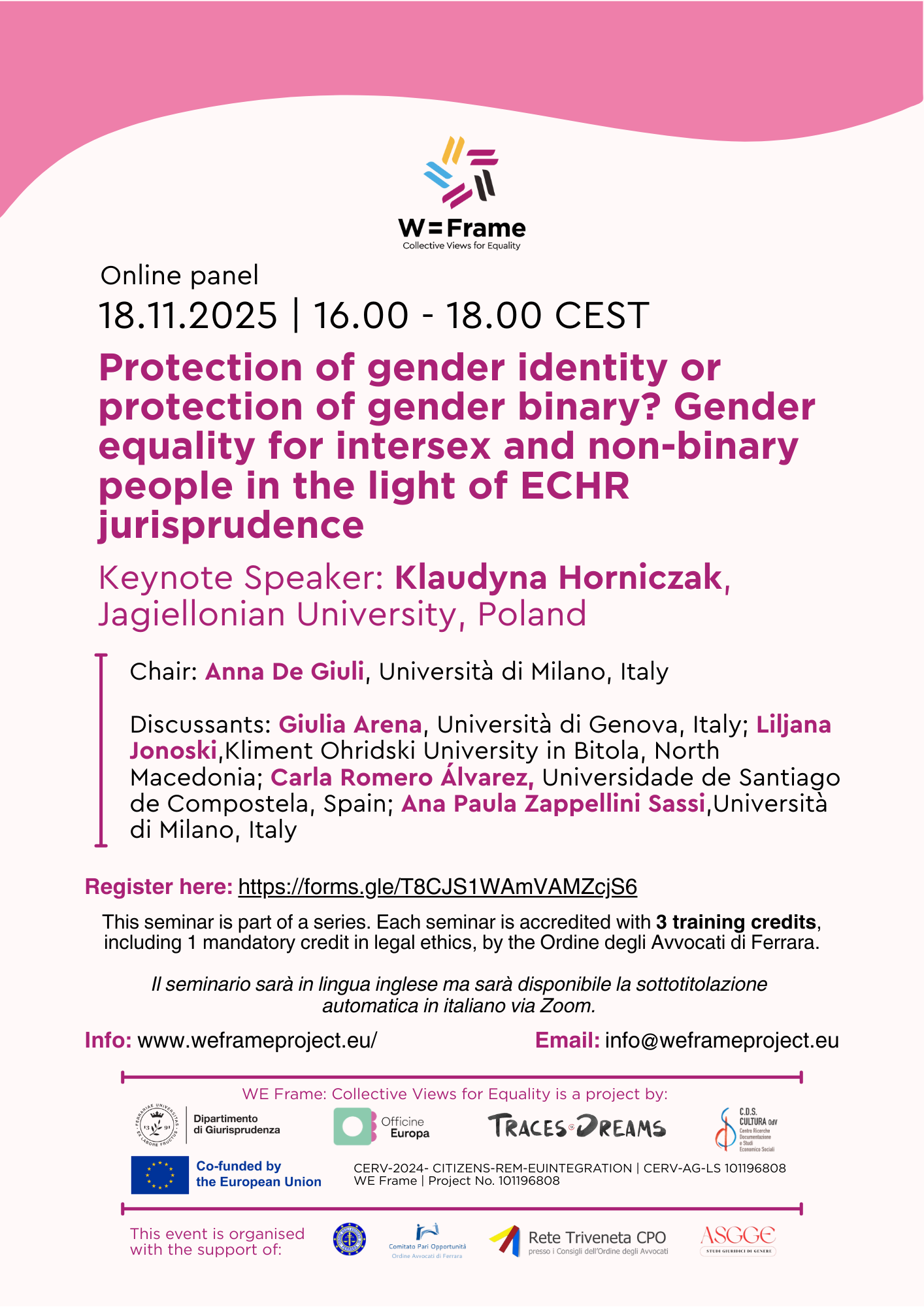
Webinar: Protection of Gender Identity or Protection of the Gender Binary?
18 November 2025 | 16:00–18:00
Gender Equality for Intersex and Non-Binary People in the Light of ECHR Jurisprudence
Keynote speaker: Klaudyna Horniczak, Jagiellonian University (Poland)
Chair: Anna de Giuli, Università di Milano (Italy)
Here you can watch the recording of the keynote lecture delivered by Klaudyna Horniczak, PhD candidate in legal and political philosophy, whose research focuses on feminism, gender justice, and queer issues.
In her presentation, Horniczak examined how the European Court of Human Rights (ECtHR) addresses questions of gender identity within a legal system still largely structured around a binary understanding of gender. She critically explored the implications of this framework for intersex and non-binary people, asking whether current legal protections truly safeguard gender diversity or instead reinforce the gender binary.
A central focus of the lecture was the debate around the introduction of a “third gender” category. Horniczak argued that, while often presented as a progressive solution, this approach is limited and potentially problematic. It risks conflating the distinct experiences of intersex and non-binary people, relies on an oversimplified understanding of gender, and may unintentionally increase stigma or segregation—particularly for intersex individuals.
Drawing on the ECtHR case Y v. France, Horniczak analysed how the Court acknowledged a non-binary gender identity while nevertheless refusing to require changes to binary legal systems, citing the lack of European consensus. She critiqued this reasoning, highlighting inconsistencies with other areas of human rights jurisprudence and the Court’s tendency to conflate biological sex characteristics with gender identity.
The lecture further distinguished clearly between intersex variations in sex characteristics e non-binary gender identities, emphasising that these groups face different legal, medical, and social challenges. Particular attention was given to the situation of intersex people, including non-consensual “normalising” medical interventions in infancy or childhood, the absence of legal safeguards, and the long-term physical and psychological consequences of such practices.
Concluding, Horniczak called for a more nuanced, multidimensional understanding of gender—one that integrates biological, social, and identity-based dimensions. She advocated for stronger legal recognition of non-binary identities under Article 8 of the European Convention on Human Rights, alongside specific protections for intersex people focused on bodily integrity, freedom from discrimination, and protection from non-consensual medical interventions.
📺 The full recording of the presentation is available on this page.