
Let’s talk about cultural and family mediation | Amal Elfakharany
Amal Elfakharany is a cultural mediator and family mediator, Arabic language teacher for Italians, also religion and Arabic language teacher for Muslim community.
What is the job of cultural mediator, family mediator?
I now work in a community for unaccompanied foreign minors. Most of them are Egyptians like me, so I mediate to facilitate communication between workers and kids, also dealing with the relationship between these kids even with their parents because they came for various reasons but they always say the same answer touching on their suffering as well. And through the institutes I also do the educational projects, which we do together in the community where I work.
The family mediator and concerns family conflict within the family. Both for parents who have the intention of doing separation, divorce, but also the conflict between parents and their children at various ages, especially in the age of adolescence, also guiding families who have kids who are being followed by Sert, who have somewhat serious problems.
What is it that you studied to become a mediator?
I did a master’s degree in family mediation in Italy, and in Egypt I studied literature and pedagogy; I have a bachelor’s degree in literature and pedagogy. I also did a cultural mediation course in Egypt, but it was a course not a master’s degree.
And are working also with women, directly with women?
I also work with various associations for battered women especially Muslim women because-I explain to you-they don’t have as much confidence to go to an anti-violence center for those who are not Muslim, those who are not Arab cannot understand their suffering from their point of view, because they see that you Italians have come from another world. And unfortunately the customs that are in their countries of origin-which is not about Islamic culture, which is also not about Egyptian law-but as customs of the places where they were raised, traditional customs of their countries. Especially if they are in small towns. I don’t mean in the city because there is so much difference between those who grew up in the city and those who grew up in a small town. They often talk to me, talk about violence and then also talking about violence but there is only one kind of violence that is widespread, famous and recognized as violence for them: physical violence. Economic violence they can put up with it because it’s okay, maybe the husband has economic difficulties and even if he scolds you it’s okay because your husband you have to listen to him or say, you have to do whatever the husband says… From the point of view of religion this violence does not exist, but it is not right from the human point of view.
Is it Difficult for you?
Very difficult because there are people who see me as a witch who causes the family to be destroyed. Really. Even when I tried to teach Italian language for Muslim women or foreign women in general, there are those who saw me as a witch that through language I can destroy the family with the knowledge that I am destroying the family, with the knowledge so it is even worse. I have been judged of these people from villages from Egypt.
And so do you ever get to work with women’s groups as well.
By taking the Italian course, yes. Last year, for example, I worked with various women’s groups, and the course for them was a great gift. Actually, because they can meet together, learning one thing together, and they can find time for themselves. And this does not exist for them. Because they have to take care of the family, to take care of the children, they have to prepare everything to have the husband, even when we tried to do the course in another city, they were all afraid because maybe even the husband doesn’t accept that she takes the course. I also experienced this school year a case of a neighbor of mine who wanted, tried to take the course, and when I did the registration for her and I also found a vehicle, a volunteer who can take her to the course. But she said no. The husband said no. She was desperate, cried a lot because she does nothing in the morning-all her children in school or college and she wants to learn the language. If he was in their country, he could, but outside the country he could not.
Specially for services, you don’t just have to wait for people to come to you, but it’s very important to go to people, isn’t it?
Yes, yes, yes. I, when I took the Italian language course last year, went knocking on doors. Yes. I also went to talk directly with the husband, because there are the women who are afraid of me as well. Because you are Italian and, as they say, I became Italian. And yes, they say so, they are afraid. Because you have an association, you cooperate with social service, maybe maybe they use you as a spy to take away our children. So every year there is a new difficulty, every year there is.
A new level of sorcery!
That’s right, that’s right.
And while with your work with unaccompanied minors there are almost only males?
Yes. I also worked in a therapeutic community two years ago where there was an Egyptian woman and a Tunisian woman. The Tunisian woman who was unaccompanied because she came via the sea had a mental disability. the mother sent her own daughter into the sea either to die or to get to Italy. The other one, however, Egyptian (these are the only two female cases I worked with as a mediator), the other one was abused by her Egyptian father. She was also in the therapeutic community where I worked. I keep a relationship with them and hear from them from time to time to see how they are doing. Even though I worked, I left work and in this community because my contract ended and to understand how they are. With the Tunisian I went to celebrate her birthday with her and I have a good relationship with her guardian. Also the Egyptian woman I hear from her from time to time because she asked for administrative continuation .
What is the biggest challenge you see in your mediation work?
To be accepted, even your role accepted, and accepted as a female that you’re doing this work but also that I’m not a witch, I’m a normal person trying to help people and be conscious responsible. And so this is not the work of the witch eh! Q ere in Italy among the Italians i o was well accepted, I was not treated as badly as I was treated in my community. And instead, just yesterday, I met with our consul at the Egyptian consulate and he complimented me. He was proud of me, he said, “You are playing a very, very important role. I completely agree with you.” And when he heard about the initiatives that I did, he said, “We need a lot of initiatives like these because your role is very important. By being a cultural mediator you are like a soldier, both for Egypt and for Italy.” And so that was a great compliment for me. I came back with a lot of energy. Because people who have high culture, who do a very important role see me as a resource for what I’m doing with my work. In fact, he even gave me the opportunity, saying if there is family conflict he will help me. And this is the first time it happens that I find this willingness from even the consulate so he himself says, “If you need me in cases of family conflict I am there, I do it gladly.”
A huge recognition also for what you do, in saying I’m doing something right.
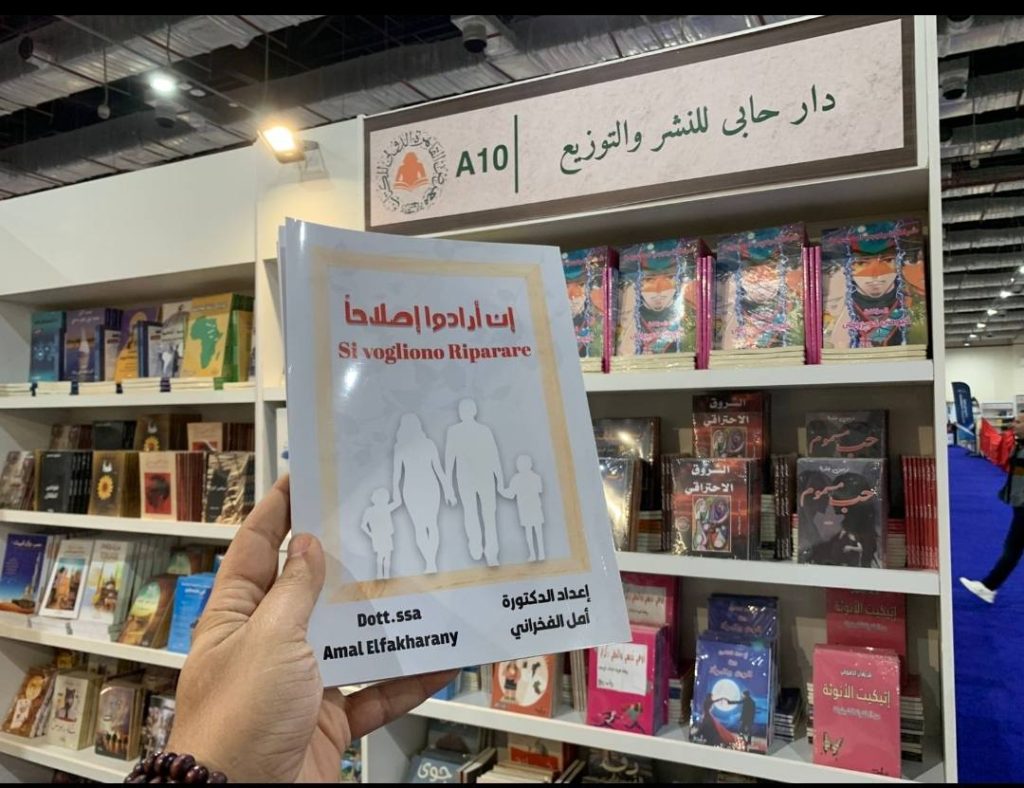
I took a un a copy of my book, because I also did a book. It’s called “They Want to Repair” which talks about family mediation, from the perspective of religion and from the perspective of Egyptian society. I also talked about real cases that are here in Italy and that was the topic of my thesis, which I did in Arabic in Italian. Right to left Arabic, left to Italian and they meet in the middle – like the mediator.
And what do you think will be the challenge of mediation ten years in the future instead?
In my opinion, it will not be too difficult as it is now, because we as Egyptians lack an example. I believe that they are now an example and there are other examples in various countries. In Italy for example I know two Egyptians, in Milan and Turin. And I would also like to tell you that one of my Italian students who studies Arabic with me wanted to be a mediator. The mediator. The only advice I can give is that we should not focus on the second generation to do cultural mediation. Why? Because they are not their Arabs. If they are Arabs, I am talking about Arabs. We no n speak Standard Classical Arabic. We speak dialects and among us Arabs we don’t understand each other. I always give the advice that when there is an Egyptian mediation case ask for Egyptian mediators. The same thing applies to Moroccans. Different cultures, even different food. I always say this in various organizations where I work, always I do word of mouth: maybe I can change something with words, because in my opinion words are very very important tool. And so even as far as the second generation is concerned, they are not of Egyptian descent because they are raised and born with another culture and then unfortunately in various families they use their child as a mediator and that is a big mistake on the part of parents.
There are the mediators who have been doing this work for years, but because there wasn’t this figure in the past they are not well informed well up to date and maybe if they get inside the case they directly give the advice of what you need to do. But that is not the role of the mediator. Don’t give advice, you bridge two different cultures.
Are there three women, three movements, three historical moments that have inspired you?
The first Muslim woman who came to my mind is called ʿĀʾisha. ʿĀʾisha was a wife of Prophet Muhammad, she was in my opinion the first Muslim feminist because she was studious, she studied a lot, she also did teachers, she also did Da’wah. She was not well accepted. After the Prophet’s death, it was not well accepted. They also did the battles against her and she also prepared an army. She was the leader of this army and she also did the battle. But unfortunately for the male mentality it was not accepted and welcome! They did not give her the opportunity to do various things, so many things, and she was just doing the teachers until she died. And so many things were said that are not right, because she was not well accepted, so what was written was also written in an unfair way.
I always speak from a religious point of view and tell you Mary. Mary, our Mary. There is a chapter in the Quran called Mary: the name of Jesus is written in the Quran 44 times, and instead the name of Muhammad, our prophet, written four times. So the story of Mary as a mom, me now as a mom for me was crucial.
And there is also Asiya, the wife of a Pharaoh who was there when the prophet Moses was there. And she who raised Moses and educated him, took care of him, even though her husband was not so good, he was very bad, but she protected Prophet Moses and was always good. And one of the people who said in the Qur’an that they will enter paradise. So for me, ʿĀʾisha, Maria and Asiya are fundamental to me.
This is part of WP1 | T.1.2. PRODUCTION OF ORIGINAL MULTIMEDIA CONTENTS: RESEARCH, STUDIES, ARCHIVAL MATERIALS, TESTIMONIES OF WITNESSES